


For a lot of people, the money question is what stops them from calling. Many of our staff at All In Solutions worried about the same thing when they were looking for treatment.
So how much does rehab cost? If you pay yourself, our estimated rates run from about $350 per IOP session to about $1,080 a day for medical detox. If you use insurance (and most private plans do cover rehab), your cost is set mostly by your deductible and out-of-pocket maximum, not by the type of care. Below, we break down costs with and without insurance, explain the insurance terms in plain English, and show you how to find your exact number before you commit to anything.
What Determines the Cost of Rehab?
It depends on how you pay:
- If you use insurance: your cost is shaped mostly by your deductible, coinsurance and out-of-pocket maximum. These numbers are usually the same no matter which level of care you start in. Some plans charge a set copay for each admission instead.
- If you pay yourself: your cost depends on your level of care (medical detox and residential cost more per day than PHP or IOP) and how many days or sessions you need.
You may have seen scary averages online. Don’t let them stop you. Those numbers lump every kind of program together and tell you nothing about your plan.
Insurance Terms, Defined
You’ll hear these words when you check your benefits:
| Term | What it means |
|---|---|
| Deductible | What you pay for covered care each year before your plan starts paying. It applies to all your health care, not just rehab. |
| Coinsurance | After your deductible, the percentage of each bill you pay, like 20% or 50%. Your plan pays the rest. |
| Copay | A flat fee for a service. Some plans charge a copay per admission, such as $2,000 for PHP. |
| Out-of-pocket maximum (OOP max) | The most you’ll pay for covered care in a plan year. After you reach it, your plan pays 100% of covered care for the rest of the year. |
| Allowed amount | The amount your plan agrees to pay for a service. Your deductible and coinsurance are based on this number, not on what the facility charges. |
| In-network | A provider with a contract with your insurance company. |
| Out-of-network | A provider without a contract with your insurer. Your plan may still pay through its out-of-network benefits, usually with a separate deductible and OOP max. |
| Prior authorization | Approval from your insurer before certain care starts. Our admissions team usually handles this for you. |
How Much Does Rehab Cost With Insurance?
Most plans work the same basic way:
- You have a deductible and an out-of-pocket maximum.
- Both are usually different for in-network and out-of-network care.
- Neither one is specific to addiction treatment. They cover all your health care, except services your plan carves out with their own copay, like primary care or ER visits.
- They usually don’t change based on your level of care.
That’s why nobody can give you a real “with insurance” price from a chart.
An Example: 10 Days in Detox
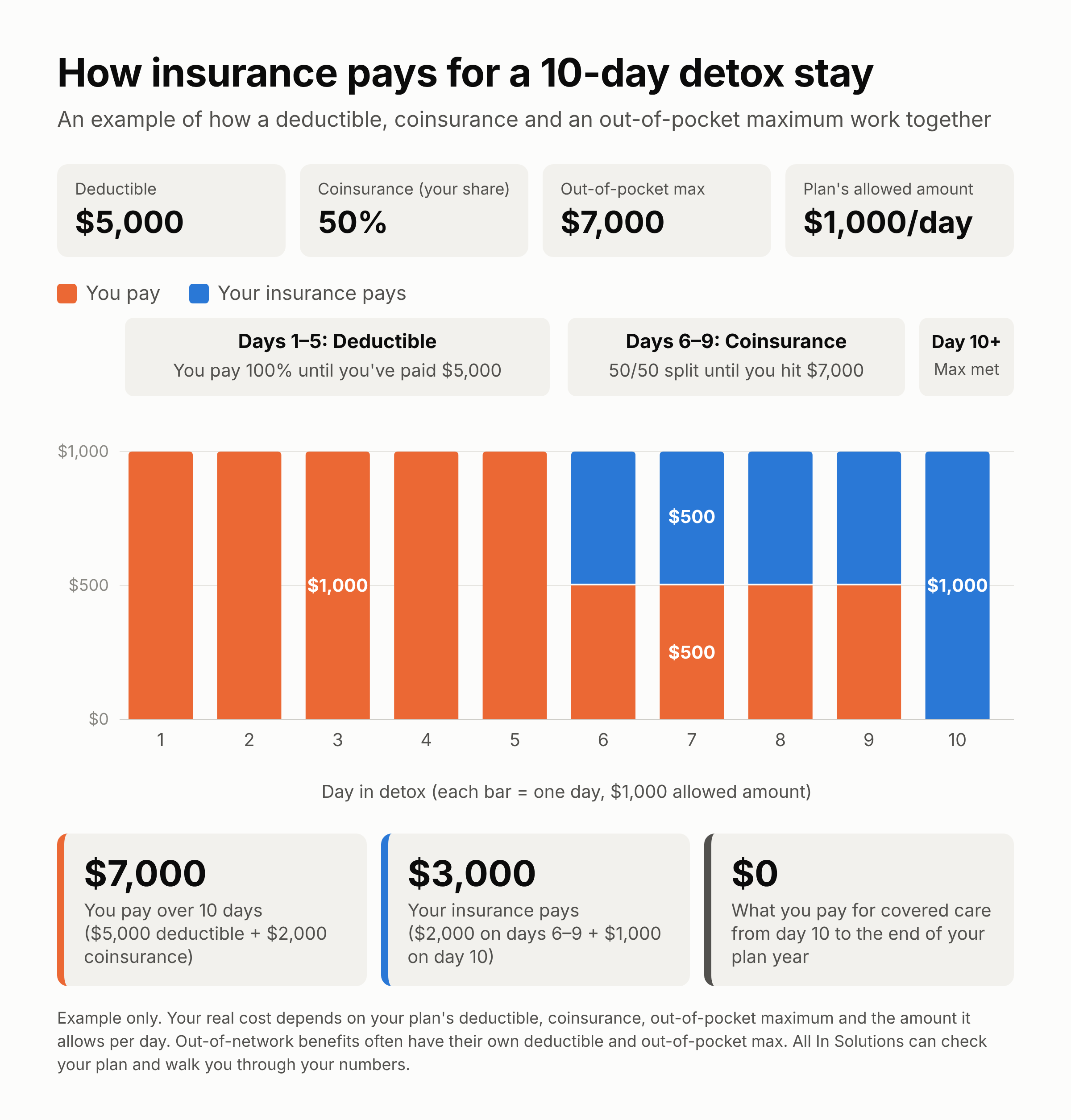
Say your plan has a $5,000 deductible, 50% coinsurance and a $7,000 out-of-pocket maximum. For detox, your plan allows $1,000 per day.
- Days 1–5: you pay the full $1,000 a day until you’ve met your $5,000 deductible.
- Days 6–9: you and your plan split each day 50/50. You pay $500 a day, which adds $2,000 and brings you to your $7,000 out-of-pocket max.
- Day 10 on: your plan pays the full $1,000 a day for covered care, for the rest of your plan year.
Your total for those 10 days is $7,000. Stay longer, or step down to PHP or IOP, and you’d usually owe nothing more for covered care that year.
Your own numbers depend on your plan’s deductible, coinsurance, out-of-pocket max and allowed amount. That’s exactly what our insurance check finds out for you.
Plans With a Copay per Admission
Some plans skip the deductible-and-coinsurance math and charge a set copay each time you’re admitted to a level of care. For example:
| Level of care | Example copay per admission |
|---|---|
| Medical detox or residential |
$4,000 |
| Partial hospitalization (PHP) |
$2,000 |
These are example numbers only. Your plan’s copays, and whether your plan uses them at all, are what we check for you.
How Much Does Rehab Cost Without Insurance?
If you pay for treatment yourself, you pay a set rate for each day or session. That’s the one case where length of stay drives your total.
Estimated self-pay costs at All In Solutions
| Level of care | Typical length | Estimated self-pay cost | About per day |
|---|---|---|---|
|
Medical detox |
5–10 days | ~$6,500 for 6 days | ~$1,080/day |
|
Residential treatment |
30 days typical; often 30–90 |
~$27,500 for 30 days |
~$920/day |
|
Partial hospitalization (PHP) |
2–6 weeks |
~$15,000 for 30 treatment days |
~$500/day |
|
Intensive outpatient (IOP) |
Several weeks to several months |
~$10,400 for 30 sessions |
~$350/session |
Your clinical team sets your length of stay based on how you’re doing, not on a fixed calendar.
One thing to know: money you pay outside your insurance usually doesn’t count toward your deductible or out-of-pocket max. If you have insurance, check your benefits first. It may cost you less.
Do Rehabs Offer Payment Plans?
Many do, and we do. We’re not here to bankrupt anyone. Our goal is to get you sober, and our admissions team will work with you on a payment plan that fits your situation. Ask for a written quote for your full stay so you know exactly what’s included before you start.
How Much Does Alcohol Rehab Cost, and Does Insurance Cover It?
Alcohol rehab costs about the same as drug rehab at the same level of care. Insurance treats it the same way too. Your deductible and out-of-pocket max apply just as they would for any other treatment.
The difference is usually the first step. Many people who drink heavily every day need to start with medical detox, because alcohol withdrawal can be life-threatening without medical care. It can cause seizures and delirium tremens (DTs). The good news is that most insurance plans cover medical detox for alcohol when it’s medically necessary, and that’s often the start of alcohol addiction treatment that keeps going after withdrawal is over.
Does Insurance Cover Rehab?
Usually, yes. Most private health plans cover addiction treatment when it’s medically necessary, including inpatient rehab. Covered care usually includes:
- Medical detox: 24/7 medical care to manage withdrawal safely.
- Residential (inpatient) treatment: you live on site and get daily therapy and support.
- Partial hospitalization (PHP): full days of structured treatment, with evenings at home or in sober living.
- Intensive outpatient (IOP): several therapy sessions a week, so you can keep up with work, school or family.
How Do Federal Laws Protect Your Coverage?
- The Affordable Care Act requires individual and small-group health plans to cover substance use disorder treatment as an essential health benefit.[1]
- The Mental Health Parity and Addiction Equity Act (MHPAEA) says that if a plan covers addiction treatment, it can’t make that coverage harder to use than its medical coverage. For example, it can’t set tighter visit limits or stricter prior authorization rules.[2]
Your plan still decides what’s medically necessary for you. That’s why checking your specific benefits matters.
How Does Out-of-Network Insurance Work for Rehab?
All In Solutions is an out-of-network provider. We accept out-of-network benefits from almost all major private insurance carriers, including Aetna, Allied Benefit Systems, Blue Cross Blue Shield, Cigna, Harvard Pilgrim, Medica and UnitedHealthcare.
Here’s how out-of-network benefits work:
- Your plan type matters. PPO and POS plans usually include out-of-network benefits. HMO and EPO plans cover rehab too, but generally only in-network, except in emergencies or with an approved exception.
- You have a separate out-of-network deductible and out-of-pocket max. It works the same way as the example above, just with your plan’s out-of-network numbers.
- Your plan pays based on its allowed amount. Out-of-network plans set an “allowed amount” for each service. If a facility’s charges are higher, your insurance statement may show a balance. If you ever get a bill from us that worries you, call us. We’ll go through it with you and set up a payment plan you can manage. We’re here to help you get sober, not to bankrupt you.
- For covered care, your out-of-pocket maximum caps what your plan expects you to pay in a year. Our admissions team will walk you through your numbers, and compare them to our private pay rate, before you start.
Why do people choose out-of-network care? Usually it’s because they want the right program for their situation, not just the nearest name on a list. Out-of-network benefits give you that choice.
Why a PPO Plan Matters at All In Solutions
If you have a PPO or POS plan, there’s a good chance your out-of-network benefits can help pay for treatment with us. We’ll check your plan, explain your numbers and tell you what to expect before you arrive.
Insurance logos on a website don’t tell you what your plan covers. Fill our our quick form to check if your insurance covers rehab, or call with your plan details.
How Does Insurance Verification Work?
Insurance verification is a quick check our admissions team runs for you. It happens in two steps:
- We look up your benefits on your insurance company’s online provider portal.
- A verification specialist calls your insurance company directly, such as Blue Cross Blue Shield or UnitedHealthcare, to confirm those benefits verbally.
From that, we learn:
- Active coverage: your plan is active and ready on the day you arrive.
- Your out-of-network benefits for the level of care you need.
- What you’ll actually pay: how much of your deductible is left, your coinsurance or copay, and how close you are to your out-of-pocket max.
- Prior authorization: what approvals your insurer needs up front, so there are no surprise denials.
All we need is the information on your insurance card: the insurance company, member ID and group number, plus the policyholder’s name and date of birth.
Your Insurance Check Is Private, Even From Your Employer. A lot of people put off checking their benefits because they think someone will be notified. That’s not how it works. We only talk to your insurance company, like Blue Cross Blue Shield or UnitedHealthcare. We never contact your employer or HR department. Checking your benefits isn’t a claim, and your insurance isn’t charged anything. Nobody gets an alert that your benefits were checked: not your employer, not the policyholder on your plan, nobody.
Our insurance verification form takes a few minutes to fill out, and we usually get back to you within an hour. It costs nothing to check and doesn’t commit you to anything. We’ll walk you through your full cost before you or your loved one ever walks through our doors.
Does Medicaid or Medicare Cover Rehab?
Does Medicaid cover rehab?
Yes. Medicaid covers substance use disorder treatment in every state, but covered levels of care and approved providers vary by state.
Does Medicare cover rehab?
Yes. Medicare covers inpatient care, partial hospitalization and, since 2024, intensive outpatient services for substance use disorders when they’re medically necessary.[3]
All In Solutions does not currently accept Medicaid or Medicare. We also don’t accept Ambetter, most Kaiser Permanente plans, Oscar or Molina. If you have one of these plans, the resources below can help you find a program that takes your coverage.
How to Pay for Rehab If Insurance Won’t Cover It
You still have options:
- Appeal the denial. If your insurance company denies coverage for treatment, you have the right to ask it to reconsider. This is called an internal appeal. If it still says no, you can usually ask for an external review by an independent third party.[7] Ask your provider for help. They can often send records that show why the care is medically necessary.
- Ask about private pay and payment plans. Ask for a written quote for the full stay. We’ll work with you on a payment plan.
- Ask about sliding-scale fees. Many nonprofit and community health centers adjust fees based on household income.
- Ask your state or county about funded programs. Every state gets federal grant money for people who can’t afford addiction treatment. Your county health department or state substance use agency can point you to state-funded beds.
- Call the SAMHSA National Helpline at 1-800-662-4357. It’s free, confidential and open 24/7, 365 days a year, and can refer you to local programs, including ones that take Medicaid, Medicare or no insurance.[4]
- Search FindTreatment.gov. This federal locator lets you filter by payment type, including Medicaid, Medicare, sliding scale and state-funded programs.[5]
If a clinical assessment recommended medical detox, especially for alcohol or benzodiazepines, don’t switch to a lower level of care just because it costs less. Withdrawal from these substances can be dangerous. Our admissions team can help you find a safe option that fits your budget.
Check Your Insurance Today
Don’t let cost keep you from getting help. Finding out what your plan covers is quick and confidential, and it doesn’t commit you to anything.
Where we offer each level of care:
Medical detox and residential treatment
Partial hospitalization (PHP) and intensive outpatient (IOP)