


You’re scared. Maybe you’re also tired, angry, or guilty, and you’ve lost count of the talks that went nowhere. Many of us sat where you’re sitting. If you’re searching for how to do an intervention for an alcoholic, you’ve already taken a real step toward helping someone you love.
An alcohol intervention is a planned, caring conversation. Its goal is simple: help your loved one accept treatment, ideally that same day. This guide covers how to help an alcoholic before things get worse. You’ll learn the warning signs of alcoholism, how to tell if it’s time, and what to say. You’ll also learn what to do if they refuse, and how to help an alcoholic get help once they say yes.
You don’t have to wait for rock bottom. You don’t have to do this alone either.
What Is an Alcohol Intervention?
An alcohol intervention is a planned meeting where family and friends share how a loved one’s drinking has affected them, then ask that person to start treatment. It isn’t an ambush or a shouting match. Done well, it’s a clear, loving offer: here’s what we’ve seen, here’s how much we care, and here’s the help that’s ready for you today.
Most interventions are for someone with alcohol use disorder, or AUD. AUD is a medical condition in which a person can’t stop or control drinking, even when it hurts their health, work, or relationships. It isn’t a lack of willpower or a moral failing. That’s why we treat it, and why the people who love someone with AUD often need a plan instead of another argument.
A good intervention has three parts:
- Your stories. Each person describes specific moments when the drinking hurt them, using “I” statements.
- A treatment plan. A program is already chosen, insurance is checked, and a bed or start date is held.
- Clear boundaries. Each person says what they’ll change if their loved one says no, and means it.
Is It Time? How to Know When to Do an Intervention for Your Loved One
It’s time to consider an intervention when drinking keeps causing harm, your loved one can’t cut back on their own, and talking hasn’t changed anything. Families often wait for a single dramatic moment. But most of the time, the signs pile up slowly, and waiting only gives the problem more room.
Warning Signs of Alcoholism Families Notice First
The National Institute on Alcohol Abuse and Alcoholism (NIAAA) lists 11 symptoms of alcohol use disorder. At home, they often look like this:
- They drink more, or for longer, than they meant to.
- They’ve promised to cut back and couldn’t.
- A lot of their time goes to drinking or recovering from it.
- Drinking is causing problems at work, at school, or at home.
- They keep drinking even though it’s hurting relationships.
- They’ve dropped hobbies, friends, or family events.
- They drive, swim, or have unsafe sex after drinking.
- They keep drinking despite blackouts, anxiety, depression, or health problems.
- They need more alcohol to feel the same effect.
- They get shaky, sweaty, sick, or restless when alcohol wears off.
The “Is It Time?” Readiness Checklist
Answer yes or no for your loved one, based on the past 12 months. This checklist isn’t a diagnosis. Only a clinician can diagnose AUD. It’s a way to see the pattern clearly.
For families worried about a loved one's drinking
Is It Time?
Check what's true for the past 12 months, then see what your answers mean. It takes about a minute.
What your answers mean: NIAAA describes 2–3 symptoms as mild AUD, 4–5 as moderate, and 6 or more as severe. If you checked 2 or more of the first seven questions, it’s worth talking to a professional. If you checked 4 or more, it’s time to start planning an intervention. If you checked any of the last three, you need support too, whatever your loved one decides.
When to Skip the Intervention and Get Emergency Help
Some situations are too urgent to plan around. Use this table to decide your next move.
| Situation | What it looks like | What to do |
|---|---|---|
| Emergency | Seizures, confusion, hallucinations, unresponsiveness, talk of suicide, or threats of violence | Call 911. For suicide risk, call or text 988. Don’t stage an intervention. |
| Plan with a professional | History of mental illness, violence, or suicide attempts; using other drugs with alcohol; past interventions that failed | Bring in an interventionist, counselor, or doctor before you plan anything. |
| Family-led planning | Drinking is causing clear harm, but there’s no immediate danger | Follow the 8 steps below. A professional is still a smart addition. |
Is It Ever Too Early, or Too Late?
It’s rarely too early, and it’s never too late. You don’t need to wait for a DUI, a lost job, or a hospital stay. Earlier help is usually easier help. According to NIAAA, most people with AUD can reduce their drinking or quit entirely with treatment. If your loved one has been drinking for decades, that’s a reason for medical support, not a reason to give up.
Types of Alcohol Interventions: Which Approach Fits Your Family?
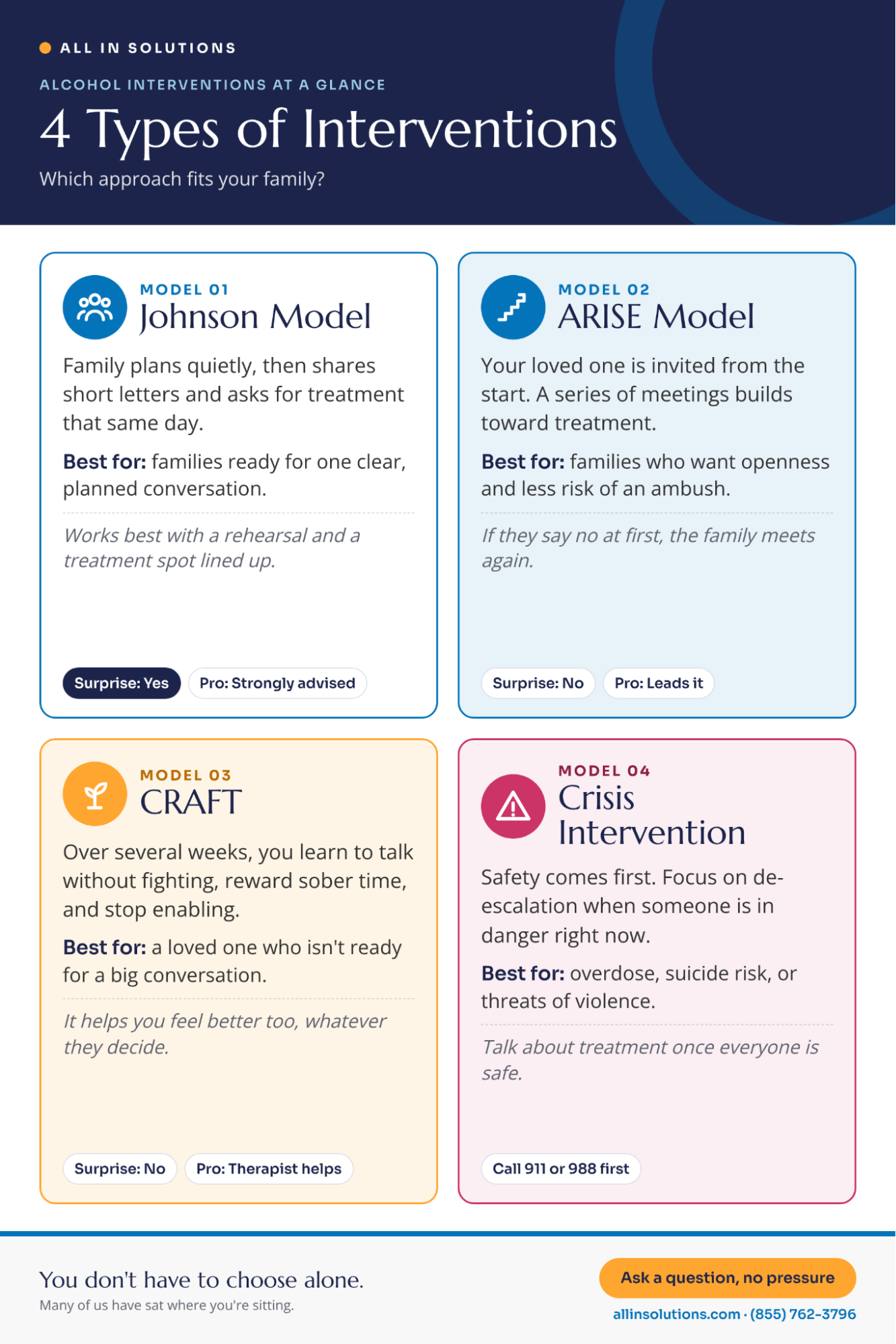
There are four main types of alcohol intervention: the Johnson model, the ARISE model, CRAFT, and crisis intervention. The right one depends on your loved one’s history, your family’s comfort with confrontation, and how urgent things are.
| Model | How it works | Best for | A surprise? | Professional needed? |
|---|---|---|---|---|
| Johnson model | Family plans in secret, then shares prepared letters and asks for treatment that day | Families ready for one clear, planned conversation | Yes | Strongly recommended |
| ARISE model | Loved one is invited in from the start; a series of meetings builds toward treatment | Families who want transparency and less risk of feeling ambushed | No | Yes; it’s led by a trained professional |
| CRAFT | Family members learn new ways to talk, reward sober time, and stop enabling, over weeks | A loved one who isn’t ready for a big conversation | No | A CRAFT-trained therapist helps |
| Crisis intervention | Focus on immediate safety and de-escalation | Danger right now: overdose, suicide risk, violence | No | Call 911 or 988 first |
The Johnson Model
This is the classic intervention most people picture. A small team plans quietly, rehearses, and meets with your loved one at a set time. Each person reads a short letter, then the group asks for a decision right away. It’s direct, which can be powerful. It can also feel like an ambush if it’s poorly planned, so a professional’s help matters.
The ARISE Model
ARISE, short for A Relational Intervention Sequence for Engagement, starts with honesty. Your loved one is told about the meeting and invited in. If they don’t agree to treatment at first, the family meets again, with more structure each time. It suits families who worry a surprise would break trust.
CRAFT: When Your Loved One Isn’t Ready for a Big Conversation
CRAFT stands for Community Reinforcement and Family Training. Instead of one big event, you learn skills over several weeks. You’ll learn how to talk about drinking without a fight, reward sober moments, let natural consequences happen, and spot the right time to suggest treatment. CRAFT also helps you feel better, whether or not your loved one changes. It pairs well with motivational interviewing, a technique clinicians use to help people find their own reasons to change.
Crisis Intervention
If someone is in danger right now, safety comes first. Call 911 for a medical emergency, or call or text 988 for the Suicide & Crisis Lifeline. The conversation about treatment can come once everyone is safe.
How to Do an Intervention for an Alcoholic in 8 Steps
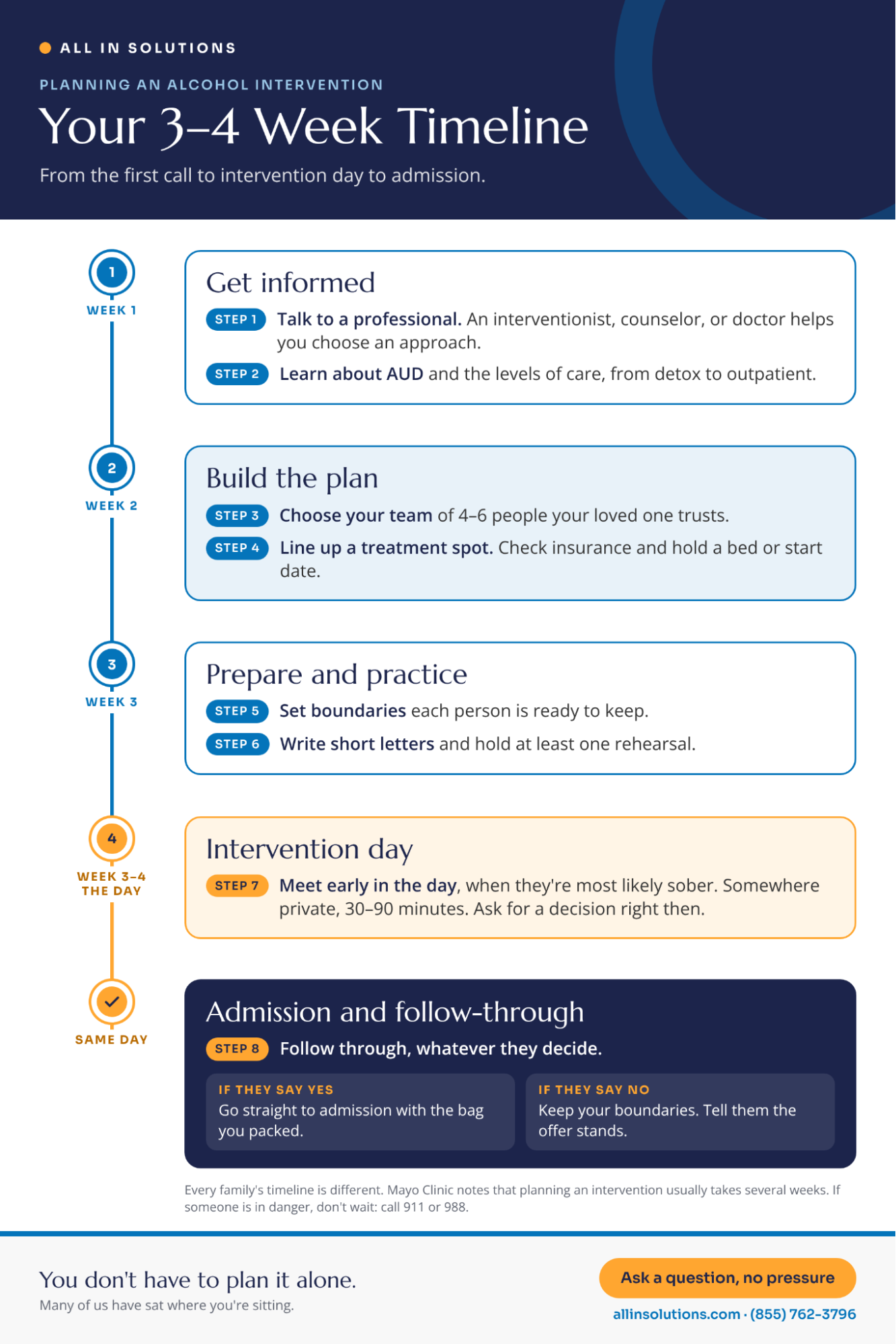
To do an intervention for an alcoholic, talk to a professional, learn about treatment, build a small team, and line up a program. Then set boundaries, write and rehearse letters, hold one calm meeting, and follow through. Here’s each step.
- Talk to a professional first.
- Learn about alcohol use disorder and treatment options.
- Build your intervention team.
- Line up a treatment spot before the day.
- Decide on boundaries and consequences.
- Write and rehearse your letters.
- Hold the intervention.
- Follow through, whatever they decide.
Step 1: Talk to a Professional First
Start with a call, not a confrontation. An interventionist, addiction counselor, social worker, or doctor can help you pick the right approach and spot safety risks. Mayo Clinic notes that professional help is especially important if your loved one has a history of mental illness, violence, or suicidal thoughts, or uses several substances.
Step 2: Learn About Alcohol Use Disorder and Treatment Options
The more you know, the steadier you’ll feel when your loved one pushes back. Learn the basics of AUD, how alcohol withdrawal works, and what each level of care offers. If your loved one also struggles with anxiety, depression, or trauma, look for a program that treats co-occurring mental health conditions at the same time.
Step 3: Build Your Intervention Team
Choose about 4 to 6 people your loved one loves, respects, or depends on. Mayo Clinic suggests this size. Good choices include a spouse, parent, sibling, adult child, close friend, or faith leader.
Leave out anyone who:
- Is drinking or using drugs heavily themselves
- Your loved one strongly dislikes or distrusts
- Can’t keep their temper or might go off script
- Might warn your loved one ahead of time
If someone important can’t come, they can write a letter for someone else to read.
Step 4: Line Up a Treatment Spot Before the Day
This is the step families skip most, and it matters most. If your loved one says yes, you want them heading to care that day, before doubt creeps back in. Before the intervention:
- Choose a program and confirm it can admit your loved one.
- Check insurance coverage. You can check my insurance online in a few minutes.
- Pack a bag and arrange a ride.
- Take care of work, kids, and pets so there’s no reason to wait.
Step 5: Decide on Boundaries and Consequences
Each person decides what they’ll change if their loved one refuses treatment. A consequence isn’t a punishment. It’s you no longer protecting the drinking. Only say what you’re ready to do. Examples:
- “I won’t give you money anymore.”
- “I won’t call your boss to cover for you.”
- “You can’t live here while you’re drinking.”
- “I won’t ride in the car if you’ve been drinking.”
- “The kids won’t stay with you unless you’re sober.”
Step 6: Write and Rehearse Your Letters
Each person writes a short letter, about one to two minutes read aloud. Then hold at least one practice meeting without your loved one. Decide the speaking order and who leads. Practice staying calm when someone gets defensive or says, “You’re no better than me.” See our letter template below.
Step 7: Hold the Intervention
Timing and setting can make or break the conversation.
- When: Choose a time your loved one is most likely to be sober. Early in the day is often best.
- Where: Pick a private, calm, familiar place, like a family home. Avoid bars, restaurants, and their workplace.
- How long: Plan for 30 to 90 minutes. Keep it focused.
- How: Stay seated, speak in turns, read your letters, and present the treatment plan. Ask for a decision right then. Giving them days to think gives the drinking time to talk them out of it.
Step 8: Follow Through, Whatever They Decide
If they say yes, go straight to admission. If they say no, calmly carry out the boundaries you set, every time. Either way, keep loving them and keep getting support for yourself. Recovery and family healing take time.
Should You Hire a Professional Alcohol Intervention Specialist?
You don’t always need a professional alcohol intervention specialist, but one can make a hard day safer and more focused. Hiring one is a strong choice if there’s any risk of violence, self-harm, or serious mental illness, or if past talks have turned into fights.
What an Interventionist Does
An interventionist is a trained professional who guides your family through the process. Most will:
- Assess your loved one’s situation and recommend an approach
- Help choose the team and coach you on what to say
- Run the rehearsal and lead the meeting itself
- Keep the conversation calm if emotions run high
- Help with the hand-off to treatment
They also take some of the weight off you. On the day, you get to be a mom, a husband, or a brother, not the person running the show.
Questions to Ask Before You Hire One
- What training or certification do you have, and are you licensed?
- Which intervention models do you use, and why?
- What happens if my loved one says no?
- Do you have ties to any treatment center, and do you earn a referral fee?
- What do you charge, and what does that include?
An interventionist should help you choose the program that fits your loved one, not just the one they work with. All In Solutions doesn’t provide intervention services. We’re the treatment your family is asking your loved one to accept, and we’re glad to talk through options with you before the day.
What to Say During an Intervention, and What Not to Say
During an intervention, say what you saw, how it made you feel, and what you’re asking for. Don’t label, blame, or bring up every past mistake. The goal is to lower your loved one’s guard, not raise it.
| Say this | Not this | Why |
|---|---|---|
| “I was scared when you drove the kids home after drinking.” | “You’re a drunk and a terrible parent.” | Specific moments are hard to argue with. Labels start a fight. |
| “I love you, and I miss who you are when you’re not drinking.” | “You’ve ruined this family.” | Love keeps them in the room. |
| “I’m asking you to go to treatment today.” | “You need to get your act together.” | A clear ask gets a clear answer. |
| “I’ve made it easier for you to keep drinking, and I’m going to stop.” | “This is all your fault.” | Owning your part lowers defenses. |
| “If you say no, I won’t give you money anymore.” | “If you don’t go, I’m done with you forever.” | Only state consequences you’ll actually keep. |
How to Write an Intervention Letter
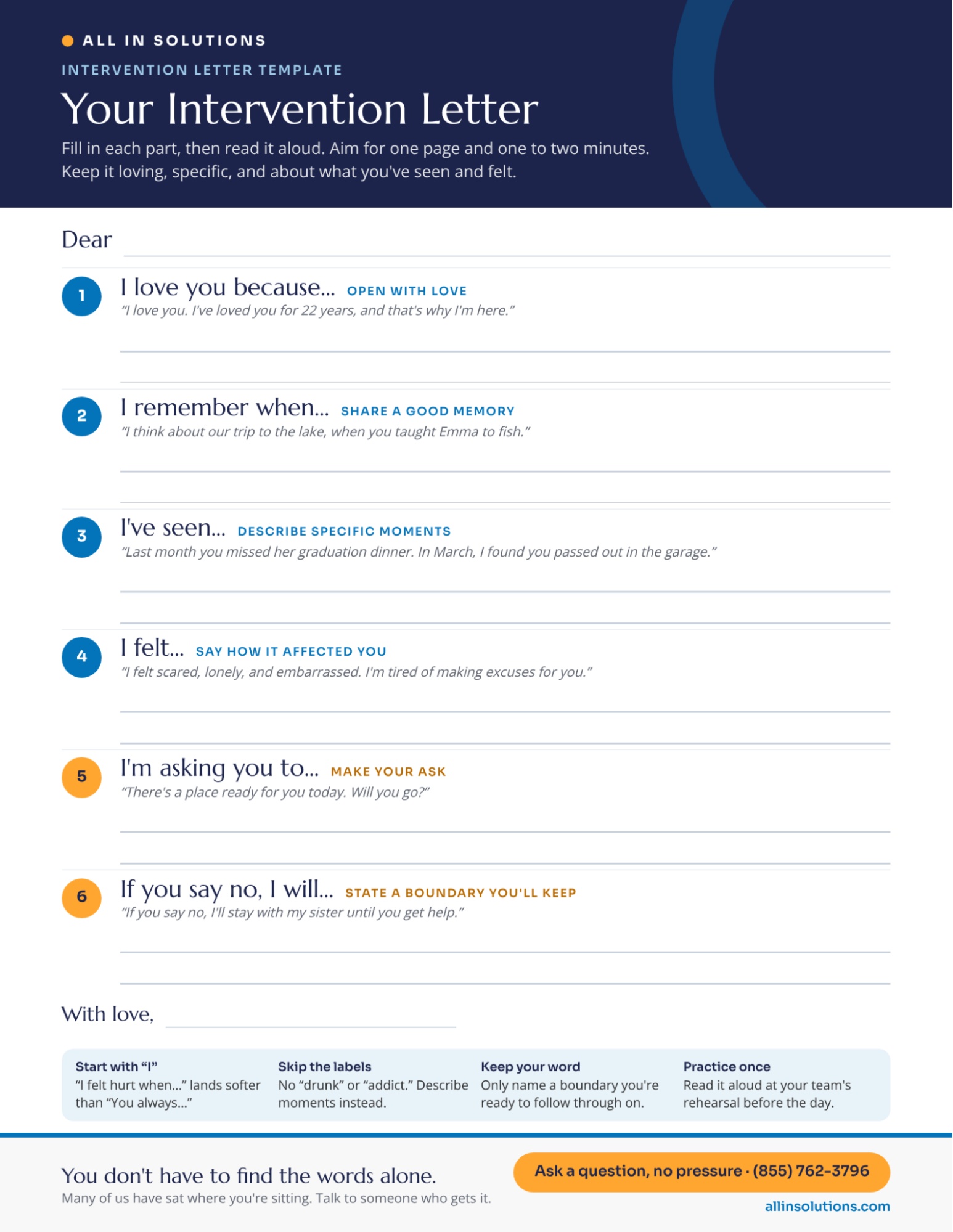
An intervention letter is a short, personal note you read aloud. Keep it to one page. Here’s a simple structure, with an example of an intervention letter to a husband.
- Open with love. “Mark, I love you. I’ve loved you for 22 years, and that’s why I’m here.”
- Share a good memory. “I think about our trip to the lake, when you taught Emma to fish.”
- Describe specific moments. “Last month you missed her graduation dinner. In March, I found you passed out in the garage.”
- Say how it made you feel. “I felt scared, lonely, and embarrassed. I’m tired of making excuses for you.”
- Make your ask. “There’s a place ready for you today. Will you go?”
- State your boundary. “If you say no, I’ll stay with my sister until you get help.”
Using “I” Statements
“I” statements describe your experience instead of judging theirs. “You always ruin holidays” invites a fight. “I felt hurt when you left Thanksgiving early to drink” invites them to listen. If you catch yourself starting with “you,” stop and restart with “I.”
Stop Enabling: The Boundaries That Make an Intervention Work
Enabling means shielding your loved one from the results of their drinking. It almost always comes from love. But it makes drinking easier to keep doing, and it can undo everything you say at the intervention.
Common enabling behaviors include:
- Giving money that ends up paying for alcohol
- Buying alcohol or keeping it in the house
- Calling in sick for them or making excuses to family
- Paying their bills, fines, or legal fees
- Cleaning up after a binge as if nothing happened
- Accepting promises to change, again and again, without any change
Stopping these isn’t cruel. It lets your loved one feel the weight of their choices, and that weight is often what moves them toward help. It also protects you. Make a list of what you’ll stop doing, and share it with your team so everyone holds the same line.
What If Your Loved One Refuses Help?
If your loved one refuses help, stay calm, follow through on your boundaries, and keep the door to treatment open. A “no” during an intervention is common. It doesn’t mean you failed, and it doesn’t mean they’ll never say yes.
In the moment:
- Don’t argue or plead. Thank them for listening.
- Calmly restate your boundary, then end the meeting.
- Tell them the offer stands. “When you’re ready, we’ll help you go.”
In the days after, keep every boundary you set. Mayo Clinic warns that empty threats teach a loved one that nothing will really change.
How to Help an Alcoholic in Denial
Denial is part of the illness, not a sign that your loved one doesn’t care. Many people truly can’t see how much drinking is costing them. Instead of debating whether they “have a problem,” point to facts and feelings: “You missed work three times this month, and I’m worried.” Ask open questions, like “What would have to happen for you to want to cut back?” Small shifts in how you talk, the kind CRAFT teaches, can open a door that arguments keep closed.
Keep Going: Al-Anon, CRAFT and Your Own Support
You can’t control your loved one’s choices, but you can take care of yourself. Groups like Al-Anon connect you with people who understand. A therapist trained in CRAFT can help you keep encouraging treatment without burning out. If you have kids at home, make sure they’re safe and have someone to talk to. NIAAA estimates about 1 in 10 children live with a parent who has AUD.
Important: Don’t Ask Them to Quit Drinking Cold Turkey
Safety note: Don’t ask someone who drinks heavily to stop on their own. According to NIAAA, stopping suddenly after long-term heavy drinking can cause withdrawal that’s painful and potentially life-threatening. Symptoms can include nausea, a racing heart, and seizures.
This is why the ask in an intervention should be “go to treatment,” not “just stop.” A doctor can plan a safe withdrawal, often with medication to ease symptoms. In medical detox, clinical staff watch over your loved one around the clock while alcohol leaves their body.
Call 911 right away if your loved one has a seizure, becomes confused, sees or hears things that aren’t there, or can’t stay awake.
What Happens After Your Loved One Says Yes
When your loved one says yes, move to admission right away, ideally that same day. Call admissions, bring the bag you packed, and drive them there yourself or with a team member.
Admission-day checklist
- Photo ID and insurance card
- A list of current medications and doctors
- About a week of comfortable clothes
- Phone numbers for family and work contacts
- A ride, arranged in advance
- A plan for kids, pets, and bills at home
Medical Alcohol Detox
For most people who drink heavily, treatment starts with medically assisted detox. Detox manages withdrawal safely so your loved one can start treatment with a clear head. Detox alone isn’t treatment. It’s the first step.
Residential Treatment, PHP and IOP
After detox, care steps down as your loved one gets stronger.
| Level of care | What it is | Where we offer it |
|---|---|---|
| Medical detox | 24-hour medical support through withdrawal | West Palm Beach, FL · Simi Valley, CA · Reseda, CA |
| Residential treatment | Live on site with daily therapy and structure | West Palm Beach, FL · Simi Valley, CA · Reseda, CA |
| Partial hospitalization program (PHP) | Full days of treatment, home or sober living at night | Boynton Beach, FL · Cherry Hill, NJ · Simi Valley, CA |
| Intensive outpatient program (IOP) | Several sessions a week around work and home life | Boynton Beach, FL · Cherry Hill, NJ · Simi Valley, CA |
Treatment for alcohol use disorder can include therapy like CBT, group support, and FDA-approved medications. NIAAA notes that the medications approved for AUD are not addictive.
How Families Stay Involved in Recovery
Your role doesn’t end at the front door. NIAAA reports that family therapy increases the chances of staying sober compared with individual counseling alone. Our family therapy program helps families rebuild trust and learn new ways to communicate. After treatment, alumni support keeps your loved one connected to people who get it.