
All In Solutions' Success Rates
A Comparison to National Benchmarks.
All In Solutions’ outcomes demonstrate measurable recovery progress built on evidence-based treatment, individualized care, and ongoing support. Drawing from the 2024 Completion & Satisfaction Report, this page details our treatment success rates, benchmarks them against national averages, and explains what makes All In Solutions one of the most trusted and transparent addiction treatment providers in the United States.
Measuring What Matters:
Real Outcomes, Real People.
In addiction treatment, “success” means more than abstinence—it means growth, emotional stability, and the ability to live a fulfilling, substance-free life. Measuring success through multiple lenses gives a clearer picture of what recovery truly looks like.
All In Solutions evaluates success using three key metrics:
Program completion rates, which reflect client engagement and treatment effectiveness.
Client satisfaction, which captures each client’s experience and perception of care quality.
Clinical outcomes, including validated assessments for depression and anxiety (PHQ-9 and GAD-7).
This data is compiled annually in the All In Solutions 2024 Completion & Satisfaction Report1, ensuring transparency and accountability. These outcomes are also contextualized with benchmarks from sources such as the Substance Abuse and Mental Health Services Administration (SAMHSA)2, the National Institute on Drug Abuse (NIDA)3, and data from national leaders like Hazelden Betty Ford Foundation4 and Caron Foundation5.
All In Solutions Inpatient
Completion Rate (2024):
*National Average Inpatient
Completion Rate (2024):
*As of February 2025, the most recent national data available on patient treatment completion rates in the United States is from the 2018 Treatment Episode Data Set—Discharges (TEDS-D) report.
Table of Contents
AIS Client
Completion Ranks
+ 30%
Above Average
Inpatient
Program Completion Rates:
A strong indicator of Engagement and Effectiveness
Inpatient Services Results
Across its detoxification and residential rehabilitation programs, All In Solutions reports an 82% client completion rate—meaning most participants stay engaged until formal clinical discharge. This sharply exceeds national trends: SAMHSA’s Treatment Episode Data Set (TEDS) shows only about 52% of individuals in residential or inpatient programs complete treatment nationwide.6 In other words, All In Solutions’ completion rate is roughly 30 percentage points higher, indicating markedly better retention and engagement.
This gap may reflect practices associated with stronger outcomes—such as individualized clinical pathways, smaller client-to-staff ratios, robust aftercare planning, and strong therapeutic rapport, all factors linked to improved engagement and reduced dropout (see SAMHSA’s Improving Retention in Substance Use Treatment Programs and NIDA guidance on treatment adherence).7, 8 Overall, the data suggest All In Solutions’ residential programs retain clients at far higher rates than comparable facilities and offer an environment where individuals are more likely to stay the course through the critical early phases of recovery.
Outpatient Services Results
At the outpatient level, All In Solutions provides care through Partial Hospitalization (PHP) and Intensive Outpatient (IOP) programs, offering structured treatment while allowing clients to maintain some independence. According to its 2024 outcomes data, 76% of participants successfully completed PHP or IOP—far above typical outpatient behavioral health norms.
Nationally, intensive outpatient completion rates are much lower. Studies cited by SAMHSA generally place IOP completion between 25% and 50%, with a frequently referenced benchmark around 26%.6 Even against the high end of that range, All In Solutions’ 76% completion rate represents a substantial improvement—roughly 50 percentage points higher than the 26% figure.
These strong retention outcomes suggest that All In Solutions is highly effective at keeping clients engaged through the full course of care. While the internal report does not single out specific drivers, likely contributors include individualized care plans, close follow-up and accountability, and supportive services such as family programming or recovery coaching. Together, these elements appear to help clients remain in treatment long enough to complete it—one of the most reliable predictors of sustained recovery.
Program Completion Across AIS Locations
Percent of Clients Who Successfully Completed Our Programs 2024 vs National Average
Short-Term Inpatient (Residential)
PHP/IOP
*National averages based on 2018 TEDS-D

Did you know?
Program completion is one of the most reliable predictors of long-term recovery success. Research shows that clients who complete a full course of addiction treatment are up to twice as likely to remain abstinent one year later compared to those who leave early3.
Client Satisfaction:
A strong indicator of Engagement and Effectiveness
All In Solutions places strong emphasis on the client experience, systematically measuring satisfaction at discharge to assess care quality and therapeutic environment. In our 2024 outcomes report, 93% of clients reported satisfaction with their overall treatment experience—an exceptionally high approval rate in behavioral health.
Feedback showed consistently strong ratings across key dimensions. About 95% of respondents felt safe and comfortable in the facilities and were satisfied with accommodations, while 97% were pleased with treatment planning and how their individual goals were addressed. Clinical engagement was similarly strong: 96% were satisfied with therapists and counselors, 94% rated educational and skills-building sessions positively, and 92% felt their medical and psychiatric needs were met with professionalism and care.
These uniformly high ratings highlight a culture of patient-centered care and continuous quality improvement. Research in behavioral healthcare shows that strong therapeutic alliances, safety, and personalized treatment are linked to better outcomes and more stable long-term recovery.9, 10 Thus, the satisfaction data not only reflect client approval but also suggest that All In Solutions’ approach effectively supports engagement and lasting recovery progress.
Scores from 2024 AIS Client Satisfaction Survey (Avg. of 1,329 responses)
Overall Facility Rating
Treatment Planning
AIS Therapists
Education Provided
When considering All In Solutions’ 93% overall client satisfaction rate, it’s important to note that national benchmarks for addiction treatment satisfaction are not standardized or centrally reported. Still, that figure is remarkably high in any healthcare setting; most behavioral health and SUD programs that survey patients report strong—but typically lower—satisfaction.
For example, alumni surveys from Hazelden Betty Ford, one of the nation’s most established networks, found that 88% of patients rated their quality of life as “good or better” one year post-treatment—an indirect but meaningful indicator of lasting satisfaction with care and outcomes.11 Likewise, a 2019 evaluation of state-funded programs across multiple states reported that about 85–90% of clients were “satisfied” or “very satisfied” with services, based on NSUMHSS data published by SAMHSA.12
Against this backdrop, All In Solutions’ 93% satisfaction rate sits near the top of the field. Even recognizing that discharge surveys mainly capture feedback from completers (who may be more positive), this still represents a strong endorsement. The program’s consistently high ratings across environment, clinical engagement, and support services suggest an atmosphere where clients feel genuinely supported and respected throughout care.
Clinical Outcomes:
Meaningful Improvements in Depression and Anxiety
Beyond retention and satisfaction, All In Solutions’ 2024 outcomes report also evaluated mental health using two standard, evidence-based tools: the Patient Health Questionnaire-9 (PHQ-9) for depression and the Generalized Anxiety Disorder-7 (GAD-7) for anxiety, both widely used across behavioral health settings to track symptom change.12, 13
Results showed substantial, clinically significant improvements in both depression and anxiety from intake to discharge—evidence that All In Solutions’ integrated approach to co-occurring mental health and substance use disorders is producing tangible benefits.
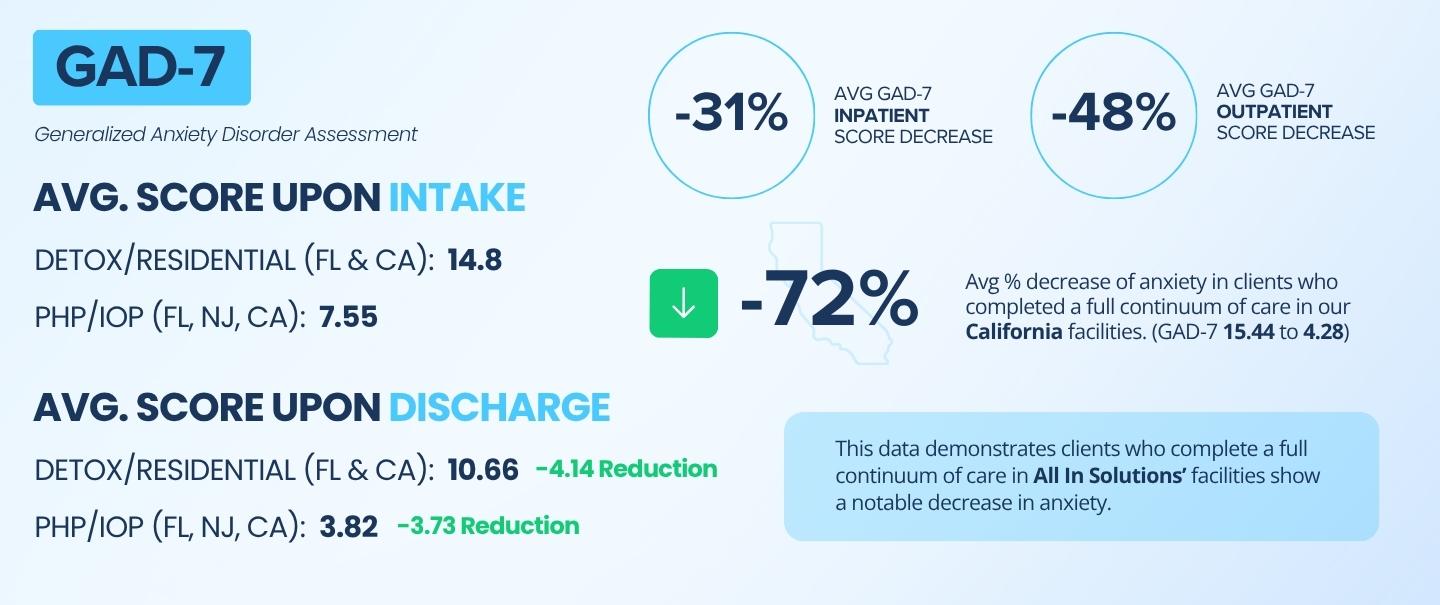
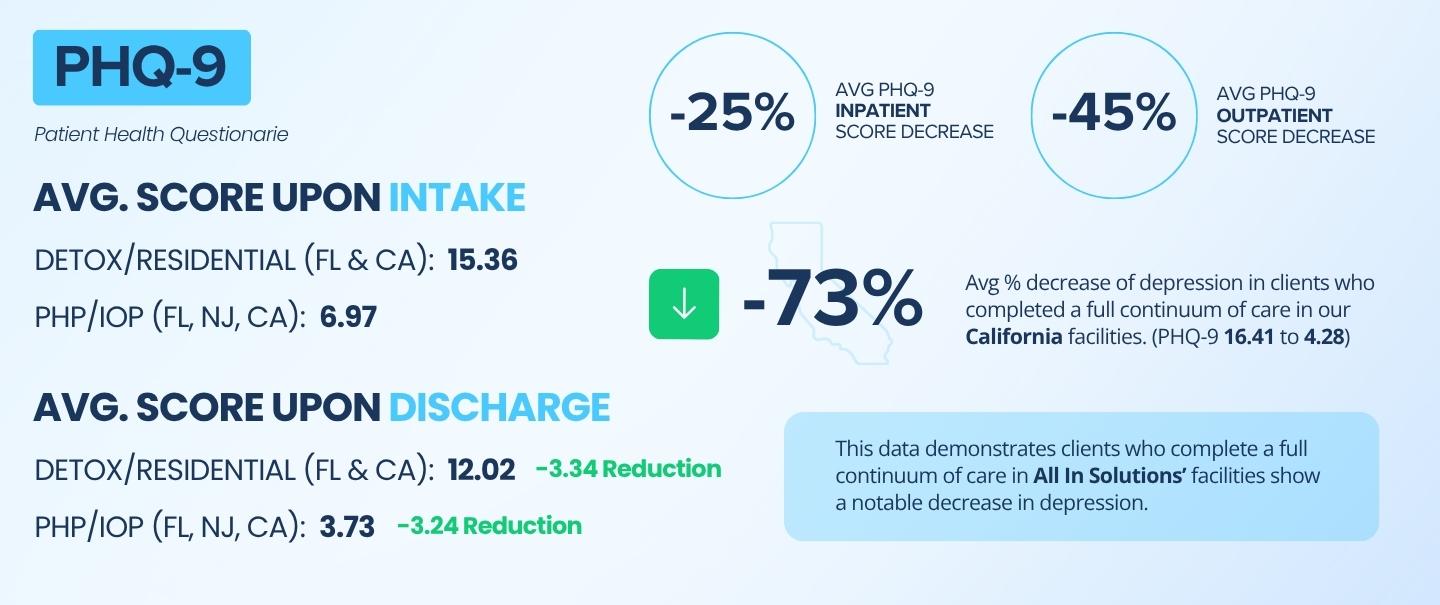
Among inpatient-only clients (detox or residential at AIS Wellness Center in Florida and AIS Detox in California), average PHQ-9 scores fell by about 3 points, a ~45% reduction in depressive symptom severity, while GAD-7 scores declined by nearly 48%. These changes reflect a shift from moderate symptoms at admission to minimal symptoms at discharge, indicating meaningful emotional relief even over a short inpatient stay.
Clients in outpatient-only programs (PHP/IOP) at AIS Counseling Centers in Florida, New Jersey, and California started with lower baseline scores (about 6–8 on both scales), yet still cut their PHQ-9 and GAD-7 scores roughly in half by discharge. At All In Solutions Counseling Center – New Jersey, for example, PHQ-9 scores dropped from 8.0 to 2.9 and GAD-7 from 8.2 to 3.0. Across all three outpatient sites, discharge averages were in the 3–4 range—levels classified by NICE as “minimal” symptoms.14
The most striking gains occurred among clients who completed the full continuum of care, transitioning from inpatient detox/residential to outpatient (PHP/IOP). These individuals entered with moderate-to-severe depression and anxiety but finished with scores consistent with remission for most participants. In Florida, PHQ-9 scores decreased from 14.3 to 3.9; in California, from 16.4 to 4.3—a ~72–73% reduction in depression severity. Anxiety improved similarly, with GAD-7 scores falling by about 70% (from 14–15 at intake to ~4 at discharge). In practical terms, clients began treatment with clinically significant symptoms and were typically discharged in the “minimal” or “subclinical” range (scores <5), aligning with clinical definitions of symptom remission.15
PHQ-9 / GAD-7 Averages
The Patient Health Questionnaire – 9 (PHQ-9) and Generalized Anxiety Disorder – 7 (GAD-7) are short screening measures used in medical and community settings to assess depression and anxiety severity. Below are the AIS Client Scale Averages Pre/Post Discharge.
Clinical Significance and Benchmarking
These improvements are not just statistically notable—they are clinically meaningful. In mental health research, a 50% reduction in PHQ-9 or GAD-7 scores is typically considered a “strong response” to treatment.15 All In Solutions’ full-continuum clients exceeded this benchmark, showing about 70% average improvement on both depression and anxiety measures.
For context, a recent Frontiers in Psychiatry study of an enhanced recovery intervention for people with substance use disorders reported a 71.5% reduction in depression and 58.5% reduction in anxiety.16 All In Solutions’ outcomes are directly comparable—and, for anxiety, even stronger—suggesting its multidisciplinary addiction and mental health model meets or exceeds established benchmarks.
These findings align with data from the Recovery Research Institute,17 which highlights improvement in co-occurring mental health symptoms as one of the strongest predictors of sustained recovery. Untreated depression and anxiety increase relapse risk and can weaken treatment engagement. By integrating trauma-informed therapy, psychiatric care, and peer recovery programming, All In Solutions helps mitigate these risks and build emotional resilience—key ingredients for long-term recovery.
What Drivers These Results:
The All In Solutions Difference
All In Solutions’ success stems from a commitment to evidence-based, individualized, and compassionate care. Several key elements distinguish the program from conventional rehab models:
Individualized Treatment Planning
Every client begins with a personalized assessment, ensuring care addresses physical, psychological, social, and spiritual dimensions.
Integrated Dual Diagnosis Treatment
Concurrent care for substance use and mental health disorders improves engagement and outcomes¹⁸
Trauma-Informed Therapy
Modalities such as EMDR and CBT help clients address underlying trauma—often a root cause of substance use.
Family and Community Support
Family education and alumni engagement strengthen recovery capital and social support networks.
Faith-Based and Holistic Options
Spiritual and holistic approaches empower clients to find meaning and purpose in recovery.
Aftercare and Alumni Programming
Ongoing support and relapse prevention services ensure continuity of care well beyond discharge.
According to NIDA’s Principles of Effective Treatment, programs that combine behavioral therapies, medication (where appropriate), and continued care produce the most durable recovery outcomes.3 All In Solutions’ integrated model mirrors these best practices—helping clients not only complete treatment, but thrive afterward.
Data Transparency
And Continuous Improvement
Unlike many addiction treatment centers that provide limited or anecdotal claims of success, All In Solutions practices full data transparency. The publication of our annual outcomes report reflects a dedication to integrity, accountability, and evidence-driven care.
By analyzing our outcome data each year, All In Solutions identifies trends, strengthens clinical protocols, and adapts programming to meet client needs more effectively. This continuous improvement model ensures the organization remains at the forefront of modern, ethical addiction treatment.
Transparency also builds trust: families and referral partners can see measurable results, rather than marketing promises.
What These Numbers Mean
For clients and families
Numbers alone don’t tell the whole story—they represent real people rebuilding their lives. Higher completion rates and improved mental health outcomes mean more clients are leaving All In Solutions with the tools, confidence, and support networks they need for long-term recovery.
For families, these outcomes provide reassurance that their loved one is receiving quality care that’s proven to work. For referring professionals, the data offer confidence that clients will be met with professionalism, compassion, and evidence-based support.
As addiction treatment continues to evolve, All In Solutions remains committed to measuring, publishing, and improving outcomes—helping to raise the standard for quality and transparency in the recovery field.
Key Takeaways
- Higher-Than-Average Completion Rates:
All In Solutions reports an 82% inpatient and 76% outpatient completion rate—well above national averages of 52% and 25–50%, respectively6 —demonstrating exceptional engagement and treatment effectiveness. - Outstanding Client Satisfaction:
93% of clients rated their overall experience positively, exceeding typical behavioral health benchmarks and reflecting the program’s strong therapeutic relationships, compassionate staff, and personalized care. - Significant Mental Health Improvements:
Clients saw an average 70% reduction in depression and anxiety symptoms (PHQ-9/GAD-7), with many reaching minimal or subclinical levels by discharge—results surpassing standard clinical response expectations.15 - Comprehensive Continuum of Care Delivers Best Outcomes:
Clients completing both inpatient and outpatient phases achieved the greatest gains—over 70% reductions in mood and anxiety symptoms—highlighting the effectiveness of structured step-down treatment models. - Evidence-Based, Integrated Approach:
All In Solutions treats substance use and co-occurring mental health disorders concurrently using proven modalities such as CBT, DBT, EMDR, and trauma-informed therapies. - Commitment to Transparency and Quality:
Through its annually published Completion & Satisfaction Report, All In Solutions demonstrates accountability, continuous improvement, and one of the industry’s strongest commitments to measurable outcomes. - Empowering Long-Term Recovery:
By combining individualized treatment, family involvement, faith-based and holistic options, and robust aftercare, All In Solutions helps clients build lasting recovery capital and lead fulfilling, substance-free lives.

Start Your Journey to Recovery
The life you deserve is waiting for you.
Call us today.